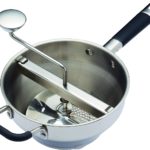
A potato ricer presses cooked potato through small holes, which gives smooth, fluffy mash without overworking it. If you don’t have one, you can get close with things already in most kitchens. Here are six ricer substitutes, roughly in order of how close they come, plus the one thing to avoid.
In short: a mouli (food mill) gives the same result as a ricer. A fine sieve comes next, then a box grater. A masher or fork works if you don’t mind a few lumps. Whatever you use, work with hot, well-drained potatoes and don’t use a blender.
Potato ricer substitutes at a glance
| Substitute | Mash texture | Effort | Best for |
|---|---|---|---|
| Mouli (food mill) | Smooth, like a ricer | Low to moderate | Big batches, no peeling |
| Fine sieve and spoon | Very smooth | High | Small amounts of silky mash |
| Box grater | Light and fluffy, slightly coarse | Moderate | A few potatoes |
| Potato masher | Rustic, a few lumps | Moderate | Everyday mash |
| Fork | Rustic | High | One or two portions |
| Wire cooling rack | Fairly smooth | Moderate, messy | An emergency |
1. A mouli (food mill)
The closest substitute, because it works the same way: a blade presses the potato through a perforated disc instead of pounding it. Use the fine disc, turn the handle and the mash drops into the bowl below, with the skins left behind in the mill. A mouli also holds more than a ricer, so it’s quicker for a big pan. If you have one at the back of a cupboard, this is the one to use. See our guide to the best food mills.
2. A fine sieve and a spoon
Put a few pieces of hot potato in a fine metal sieve set over a bowl and push them through with the back of a large spoon or a ladle, scraping the underside as you go. It gives very smooth, almost silky mash, the way chefs make restaurant-style purée. The downside is effort: it’s slow work for more than two or three potatoes. Use a metal sieve rather than a plastic one, which can split.
3. A box grater
Grating cooked potato on the large holes breaks it into light strands, much like a ricer does, without squashing it. It works best with potatoes boiled whole until just tender, so they hold together while you grate. Let them cool for a few minutes so you can handle them, then grate straight into a warm pan and fold in the butter and milk. Mind your fingers on the last piece.
4. A potato masher
The obvious choice, and fine if you like mash with a little texture. To get it as smooth as you can: make sure the potatoes are very soft and well drained, mash them on their own before adding anything, then fold in warm butter and milk at the end. Stop as soon as it’s smooth enough. The more you work potato, the gluier it gets. Our ricer vs masher comparison explains why.
5. A fork
For one or two portions, a sturdy fork does the job. Press down on the potato with the back of the fork rather than stirring, then fold in the butter. Expect rustic mash.
6. A wire cooling rack
An emergency trick: rest a clean wire cooling rack over a bowl and press hot potato through the grid with your palm or a spatula. It breaks the potato into small pieces without overworking it. It’s messy and only works with racks that have a tight grid, but it’s better than a blender.
What not to use
Don’t use a blender, food processor or stick blender. The fast blades burst the starch cells in the potato, and the mash turns gluey and elastic. An electric hand mixer on a low speed is less risky, but it’s still easy to overdo.
Tips for smooth mash without a ricer
- Use floury potatoes such as Maris Piper or King Edward.
- Cook them until a knife slides in with no resistance. Undercooked potato makes lumps whatever tool you use.
- Drain well, then let them steam dry in the hot pan for a minute.
- Work while the potatoes are hot, and warm the butter and milk first.
Is it worth buying a potato ricer?
If you only make mash a few times a year, the substitutes above will do. If you make it most weeks, or want reliably smooth mash for Sunday lunch or Christmas dinner, a ricer is quicker and easier than any of them, and it costs less than a takeaway. Our guide to the best potato ricers in the UK compares seven, from a budget ricer to the twist-action Joseph Joseph Helix. And if you do get one, here’s how to use a potato ricer.
Common questions
What is the best substitute for a potato ricer?
A mouli (food mill). It presses potato through holes in the same way, so the mash comes out just as smooth. A fine metal sieve is the next best option.
Can I use a cheese grater instead of a potato ricer?
Yes. Grate whole boiled potatoes on the large holes of a box grater, then fold in warm butter and milk. The result is light and fluffy, if slightly coarser than riced potato.
Can I use a garlic press instead of a ricer?
Only for a spoonful or two, for example for baby food. A garlic press is a tiny ricer, so it works the same way, but it holds so little that it’s impractical for a pan of mash.
Why does mash go gluey?
Overworking it. Every time potato is pounded or blended, more starch cells burst and release starch, which makes the mash sticky. Waxy potatoes and mashing after the potatoes have cooled make it worse.
As an Amazon Associate, Mouli World earns from qualifying purchases.